
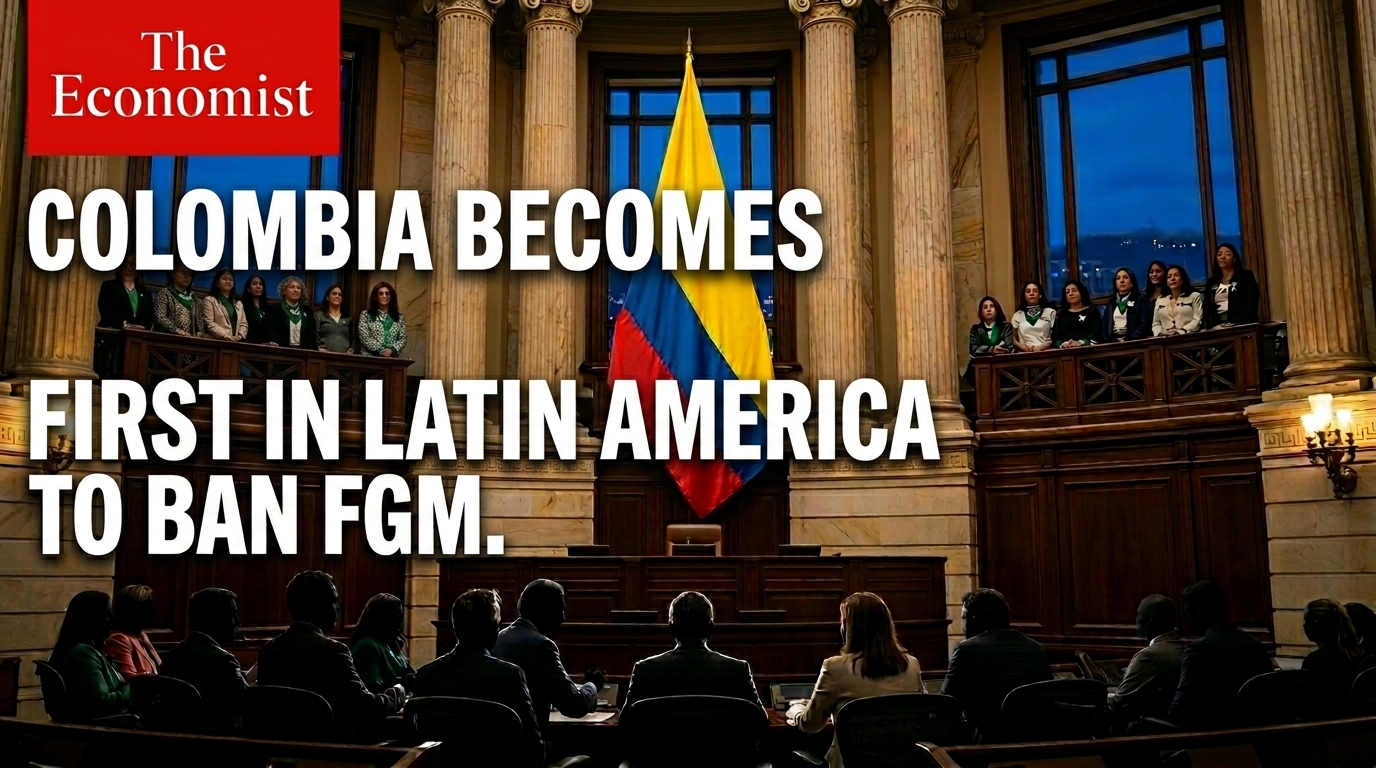
In a vote that human rights advocates had been working toward for years, Colombia's Senate on June 10, 2026 passed legislation prohibiting female genital mutilation. If signed into law by President Gustavo Petro, it will make Colombia the first country in Latin America to criminalize the practice a milestone that advocates say sends a powerful message across the region and beyond.
Female genital mutilation, or FGM, involves the partial or total removal of external female genital organs. It is practiced in some indigenous communities in Colombia's Pacific and Amazon regions, often framed as a traditional rite of passage but recognized by medical and human rights authorities worldwide as a serious violation of girls' physical integrity, bodily autonomy, and long-term health. The practice can cause severe pain, infection, complications in childbirth, and lasting psychological harm.
Globally, FGM affects an estimated 200 million women and girls in 30 countries across Africa, the Middle East, and Asia. Legal prohibitions have been in place in many of those countries for years, though enforcement varies enormously. In Latin America, the practice had not previously been the subject of dedicated criminal legislation, partly because its prevalence was relatively limited and partly because it had remained largely invisible as a policy issue.
The Colombian Senate's vote changed that. The legislation creates specific criminal penalties for anyone who performs FGM on a minor and puts in place protections for girls identified as being at risk. It also includes educational and community engagement components, recognizing that changing deeply embedded cultural practices requires more than just criminal prohibition it requires sustained, respectful work with communities.
The bill's passage was not without controversy. Some indigenous rights groups argued that the legislation was drafted without adequate consultation with the communities it primarily affects and that it risked being applied in heavy-handed ways that further marginalized already vulnerable populations. These are important concerns. The history of laws passed in capital cities that are then enforced without understanding or sensitivity in indigenous communities is long and painful, and Colombia's own history includes examples of exactly that pattern.
Advocates for the legislation acknowledged those concerns while arguing that the protection of girls from a harmful practice had to take precedence and that the law was designed with community engagement in mind.
The timing of the vote was complicated by the political turbulence surrounding President Petro, who was simultaneously facing calls in Colombia's Chamber of Representatives to have his presidential powers suspended until the June 21 election. Whether Petro would sign the FGM legislation into law before that process played out was an open question as of the day of the Senate vote.
Whatever the political context, the Senate's action represented a genuine and significant moment in the long, uneven global effort to end a practice that causes irreversible harm to millions of girls and women. Colombia's position as the first Latin American country to take this legal step gave the vote a significance that extended well beyond its own borders.
Comments (0)
Please log in to post a comment.
No comments yet. Be the first!