
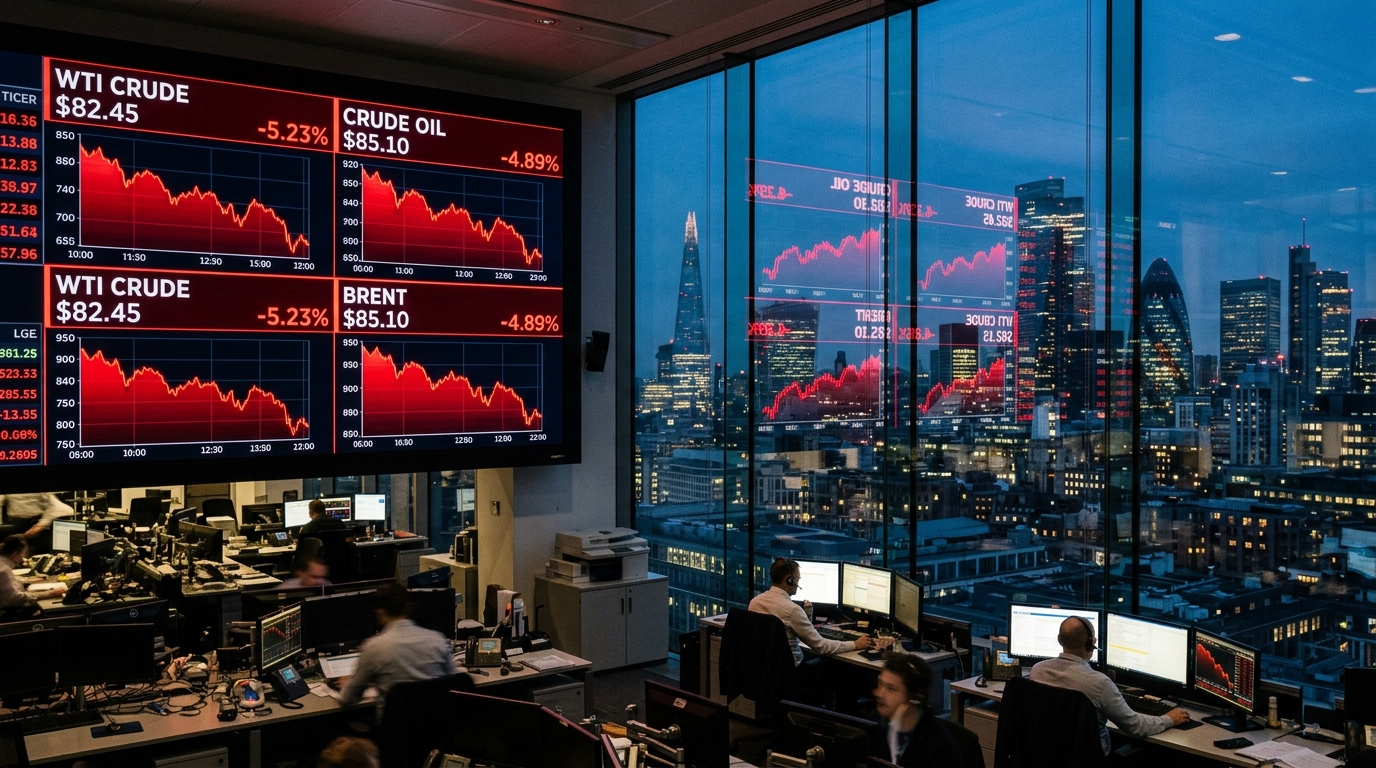
The market moved before the diplomats had finished talking.
Brent crude futures fell 1.73 percent on Wednesday to settle at $70.33 a barrel, while US West Texas Intermediate dropped more than 2 percent to $67.20. Both benchmarks touched their lowest levels since late February, before the assassination of Iran's Supreme Leader and the war that followed sent prices sharply higher. The proximate cause was straightforward: four days without a new exchange of fire in the Strait of Hormuz, a stand-down that has held since Sunday, and a pair of days of technical talks in Doha that mediators described as showing "positive progress," even without a signed agreement.
Traders have learned over the past several months to treat any de-escalation signal with some caution. The Strait of Hormuz handled roughly a fifth of the world's oil and liquefied natural gas trade before the war disrupted it, and the corridor has yet to return to anything resembling its pre-war rhythm. Shipping analyst Vandana Hari, founder of Vanda Insights, described the current state of the strait as reopening but "patchy, unpredictable, and not fully transparent," a characterization that has shown up repeatedly in the divergence between official statements and what vessel-tracking data actually shows on the water.
Still, the direction of travel has been enough to pull prices down from the elevated levels of the past week, when tit-for-tat strikes between the US and Iran briefly threatened to unravel the ceasefire framework entirely. Brent had spiked well above $70 during the worst of the exchanges; the retreat back toward $70 reflects markets pricing in a period of relative calm rather than a resolved conflict. Analysts have noted that US shale production has also been running well ahead of last year's pace, with total American crude, condensate, and natural gas liquids output averaging more than 21 million barrels a day in the first four months of 2026, a cushion that has given the market more room to absorb Middle East volatility than it had in past crises.
The price move carries a direct line to household budgets. Petrol prices in the US have been drifting down alongside crude, a welcome development for the Trump administration heading into the July 4 holiday travel period. For oil-importing economies further from the conflict, particularly in Asia, the drop offers similar relief after weeks of elevated shipping costs and insurance premiums tied to the strait's disruption.
The durability of Wednesday's price move depends entirely on what happens next in the diplomacy. With US-Iran talks now paused until after July 9 to allow for the funeral processions of Iran's late Supreme Leader, and with the underlying disputes over Hormuz tolls and frozen Iranian assets still unresolved, energy traders are treating the current price level as provisional. A renewed exchange of strikes, or a collapse of the talks once they resume, would likely reverse the move quickly. For now, though, the market is betting that the stand-down holds.

Comments (0)
Please log in to post a comment.
No comments yet. Be the first!